
As anyone knows who is privileged enough (*koffkoff*) to have me whine at them, I spent quite a lot of planning and effort gearing myself up for an early-in-the-year audition for a production of Sweeney Todd – and then didn’t get cast.

But almost immediately, while I was doing a concert of Trial by Jury (fun! I was the Counsel! It’s high for me!), I was approached by my buddies Natan and Manya. They had just put on a bare-bones, but sold-out, semi-staged Dido and Aeneas which I quite enjoyed. And Natan was taking that forward to formally start an opera company (now called Opera Picciona). And they were inviting me to play in their sandbox for their first official show, a double bill of Mozart’s Bastien und Bastienne and Offenbach’s Le 66. Possibly to music-direct, possibly just to play horn or maybe be on stage? Anyway, I was thrilled to have a new opportunity and (after taking a look at the operas) excitedly agreed to be the MD.
I’d heard of the Mozart, but not of the Offenbach. The operas are, on the surface, kind of similar. They are both one-acts, about 45 minutes each. They both involve a squabbling love-couple of soprano/tenor, with a bass/baritone trickster character who dispenses advice and/or sets things in motion. Mozart wrote Bastien when he was 12! It was a parody of another opera, you can read all about it here. There is practically no plot, and the many many short numbers are a lot alike, it took me forever to distinguish them. and although there are occasional duets, the three characters don’t sing together until the finale. The Offenbach, one of many many cute little one-acts he wrote, has a bit more of a plot – the tenor thinks he’s won the lottery, spends a lot of money he doesn’t have yet and becomes a jerk, and then finds out he didn’t actually win the lottery at all. It is also far funnier than the Mozart.
Natan was stage-directing (and producing), but he’d already solved a major musical issue before bringing me on board. Dido and Aeneas was ‘conducted’ by a keyboardist leading four string players, and I thought it wasn’t particularly tight. For “BB66”, as we called it, his plan was for an eight-person orchestra: four strings, two horns, two woodwinds. The Mozart was scored for exactly that (two oboes), but Natan realized we could have a flute player play the first oboe book and then have flute for the Offenbach. Offenbach was scored for pretty much a full orchestra, but Natan just went ahead and created an orchestral reduction for that same force of eight players. This was good – I told him right off the bat that, although I’d be happy to play piano for staging rehearsals, I did not want to be anywhere near a keyboard for performances – and with this setup, wouldn’t need to be.
So, this was great for me – in that from a certain angle, this was very much the kind of thing I’ve been doing all along (Offenbach is a logical next step from G&S), but would also be a stretch in that Mozart, as juvenile as this piece is, is honest-to-god opera. It’s Mozart! Also, both pieces would be a stretch as we’d be doing them in the original languages (German for the Mozart, French for the Offenbach). I’d never MD’d shows in a language other than English before. (We were also doing the dialogue in the same languages, which meant a lot of work for the singers memorizing it, but wasn’t really something the MD had to worry about.) But (ha ha!) thought the language thing wouldn’t be a problem.
Natan put out a call for singers to submit resumes and videos. Theoretically, you could cast both operas with the same three people, but we didn’t want to do that. (Ideally, we’d have a different cast for each of the two, and they could ‘cover’ each other.) As expected, we got a handful of tenors, a handful of baritones, and a bazillion sopranos. We dutifully reviewed the submissions and had some ‘callbacks’ that were basically interviews. There was one soprano that was familiar to us that we knew we wanted to cast, but figuring out the other was tough, particularly because we had so many good candidates. We did, unfortunately, end up losing both the baritones we cast due to conflicts, but reached out to others we knew and ended up with splendid replacements.
Natan had set a rehearsal schedule starting in late May, right before the holiday weekend. And, as it turned out, the timing worked out great, in that my April eye surgeries were all done and I managed to fit in a trip to visit my family right before we started.
The plan was to hire a rehearsal pianist for the first read-through, but then I would play piano for staging rehearsals, up to the point where we started to do runs. Staging rehearsals kind of have built-in piano practice, since you run the same scene over and over again. But I needed to have the scores basically under my fingers before we started, so I was practicing every day. I thought the Mozart would fall easily under the fingers – and some of it did – but much of it was quite complex. That evil little brilliant 12-year-old, showing off his genius. The Offenbach was much easier to play (mostly), although as I explored, I found more and more vocal score errata, which I dutifully posted to a spreadsheet available to the cast and team.
Natan had also managed to schedule all rehearsals in the facility (if not the actual room) where we were performing, the Houghton Hall Arts building at 30th and Madison. Very easy to get to. I also thought if I got there early, I could sneak into an unused practice room and practice my keyboard before rehearsal, but the one time I tried that, I actually got yelled at by the staff, so no more of that. But mostly they were very friendly and the whole first floor is a comfy lobby where you can hang out until your rehearsal starts.
We did our initial read-throughs which went great – everyone was very prepared, and there were not many problem spots. And we got the two operas staged fairly quickly, on the barest of sets. (there were a lot of props and costumes, though. Natan needed a lot of hats, and I managed to lend this great straw boater that Charles had had – which our Offenbach baritone ended up wearing) I apologized for my piano skills, and also for my unfamiliarity with the languages. The biggest problem there is that I’d tell the singers where we were starting and totally mispronounce the lyrics – which they’d then correct me on. One opera in French, one in German, and yes, I’ve done minimal singer-study in both languages, but in retrospect, I wish I had done some brushup.
My next task, once we got going, was to find an orchestra. Again, eight people. It didn’t occur to me until I started that this was the first conducting gig in a long time where the orchestra wasn’t just presented to me. OK, so Natan put out some sort of ad that allowed people to submit interest and resumes, and we also had names from the Dido orchestra and of course all our friends.
For strings, I got one of the Dido violinists, who told me up front she couldn’t make one rehearsal, and another violinist from Natan’s ad. A couple of cellists applied, but I ended up asking JP, a cellist I’d worked with a lot at Utopia Opera. He ended up having to miss a rehearsal too, but let me know in plenty of time. For horns, I asked a couple of my QUO section mates and they both said ‘yes’ right away, that was cool. (we’ve played together as hornists for years, but they’d never seen me conduct!) I asked my usual flute and oboe friends, but most of them had conflicts. Two excellent flutists had applied from Natan’s ad, and I offered it to the one who’d submitted first, who said ‘yes’. (and who was terrific and I’ll totally work with him again) And one of my QUO oboe friends said yes.
I had the darndest time finding a viola player. I don’t have a lot of viola friends, and mine were busy, and most of the QUO ones were busy as well. It took me weeks and weeks to find anyone, and I finally had to settle for someone who could only do the performances. Boy, is this dangerous. No matter how good he is, he’d be sightreading performances. I ended up making sure that the solo viola stuff was covered in other instruments, and that I got the actual violist as prepped as possible beforehand. As it turned out, he was wonderful and we were lucky there, but of course we didn’t know that until opening night.
We actually had what I thought was a reasonable amount of orchestra rehearsal time – one orch-only rehearsal, a ‘sitzprobe’, two tech/dress rehearsals before two performances. The orch-only was a bit of a struggle, but I suspect it’s because the strings didn’t realize how tough the Mozart would be. We were missing one horn for one rehearsal, one violin for the next and of course a viola for every rehearsal. But it was clear at the sitz that the panicked practicing had taken place and that rehearsal went just fine.
I also played some orchestration games. As well as doubling the viola solos with various people, I gave the flute player free reign to invent places to play piccolo instead of flute – and then also threw him in (on piccolo) for the little bagpipe ditty that underscores the Mozart bass’s entrance (the actor was faking playing the recorder, so this worked really well).
I knew the first tech/dress would be tough because we’d be missing our cellist as well as the violist, but then the first violinist called out to – a family issue, I think. OK, so now I had only one string player for an opera that was very much about the strings. (The Offenbach was a little less dire, but still.) I threw up my hands and ended up leading the rehearsal from the piano – not ideal for me but at least everyone got full chords of accompaniment rather than crickets and tumbleweeds. The final dress we had everyone but viola, but of course it was not as tight as it could have been. Also, the first violinist missed the Mozart and I had to throw his book at the flute player, who sight-read it with aplomb.
(but spirits were high. The producing team got everyone fancy chocolates, which got distributed, and I’d bought everyone branded keychains with the show art on it)
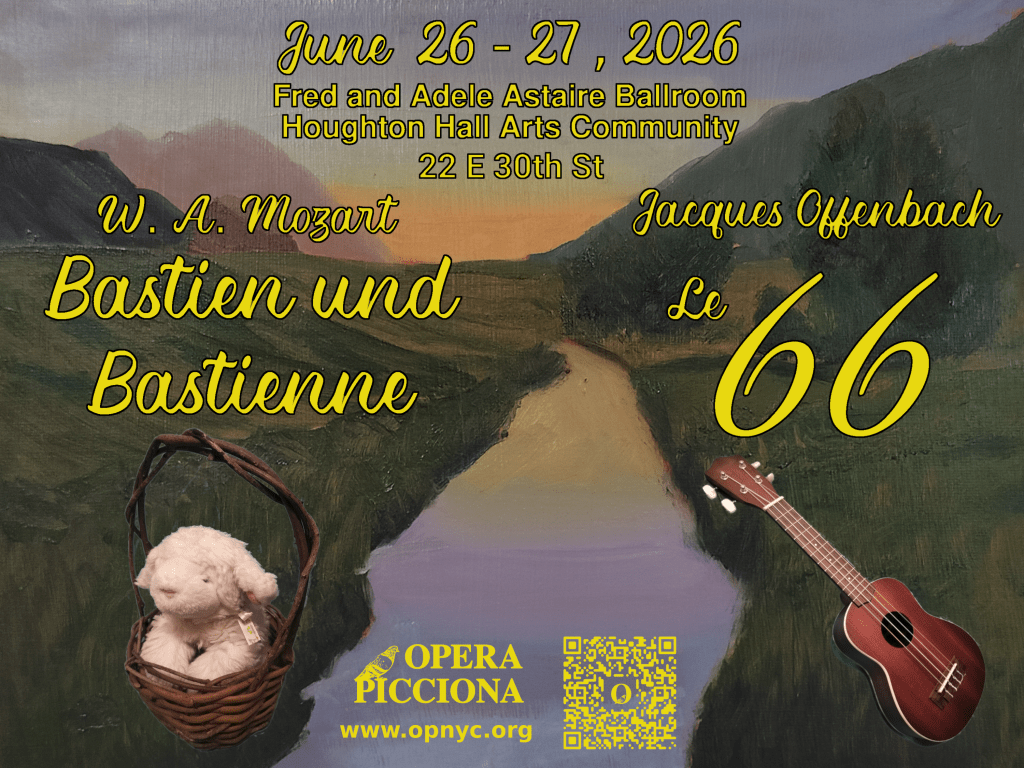
Finally opening night! Our violist showed up and turned out to be smart and an excellent player. We got a few tidbits rehearsed before the house opened. It was a small space, but we filled it with audience. I had two people from my office there!
The Mozart was perfectly OK, but shakier than I’d like from the orchestra because we really had not rehearsed it enough as a team. The Offenbach, which was far easier, went beautfully. The next night went much better (the Mozart actually felt comfortable for the first time), and again we had a full house. Very well received, a joyous experience.
And then I took a cab home and felt six weeks of ‘aaaaugh’ drop away.
So… anyway, up to performance time, it was a ‘ball of stress’ experience… but mostly delightful. The material was fun, the team was committed and the singer/actors were all terrific to work with. I think my takeaways for myself would be:
- If working in a foreign language, spend some time on Duolingo or whatever to refresh your knowledge and pronunciation.
- Take the time to play through every part from the score and from the part itself. We found so many errors that had to be fixed, and I could have caught them ahead of time.
- For really complex piano accompaniments, even if you’re just doing rehearsals, it may be worth your while to actually write out easier passages, or chord symbols.
- This was a good step in a new direction, and I should keep going.
Sorry this took a while to get out.

